
Crypto funding rates explained
Guide revised: . Data verification dates are shown separately in the guide and sources.
If you trade perpetual futures, the trading fee is only half the story. The other half is funding, and for anyone who holds a position for more than a few hours it is often the bigger cost. Here is how it works and why it matters.
What funding actually is
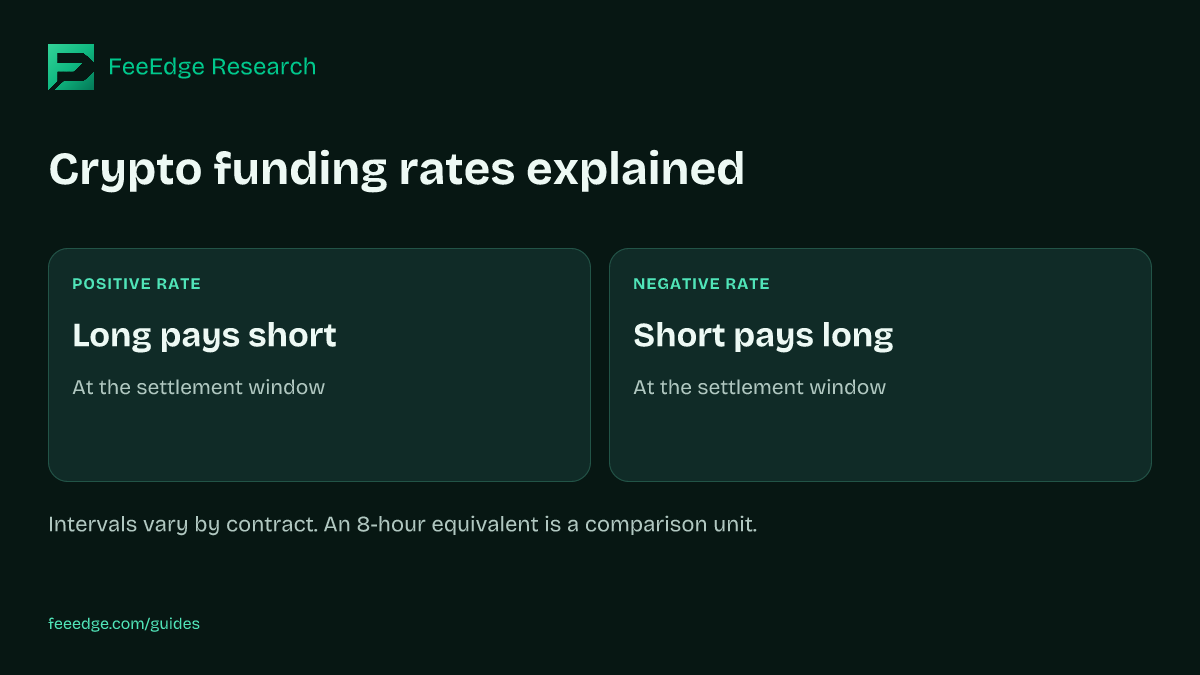
A perpetual future has no expiry, so exchanges use a funding payment to keep its price anchored to spot. At each settlement interval, longs and shorts pay each other directly based on the funding rate. Intervals vary by venue and contract; an 8-hour equivalent is a comparison unit, not a universal schedule. The exchange does not pocket it. When funding is positive, longs pay shorts. When it is negative, shorts pay longs.
Why it can beat the trading fee
You pay the trading fee twice: once to open, once to close. You pay funding every window you hold. A position held across several funding windows can rack up more in funding than the round-trip trading fee, especially in a strongly trending market where funding runs hot. That is why a venue with the cheapest taker fee is not automatically the cheapest place to hold a trade.
How to keep funding from eating your edge
Check the live funding rate before you hold, not just the trading fee. The same position can be cheaper to carry on a different venue purely because its funding is lower. Shorter holds reduce funding exposure. And if you are delta-neutral, funding can even pay you.
What FeeEdge can and cannot cost
FeeEdge collects BTC perpetual funding only. A BTC-only book is a BTC match. BTC plus Other, or any mixed book, is a labeled BTC reference, not those instruments' own rates. ETH-only stays fees only. Long and short are exposure hypotheses. A missing live quote is not treated as zero. The 0.01%/8h figure is a labeled scenario hypothesis and is not used to rank venues. Official settlement history is stored for Binance, Bybit, OKX, and Hyperliquid. Other venues still show snapshots.
The current funding board and optimizer are free, without an account. Quotes are normalized to an 8-hour equivalent so venues can be compared; this does not change their settlement intervals. Pro adds historical averages and alerts. These snapshots are not guaranteed future payments.