
The hidden costs of crypto trading
Guide revised: . Data verification dates are shown separately in the guide and sources.
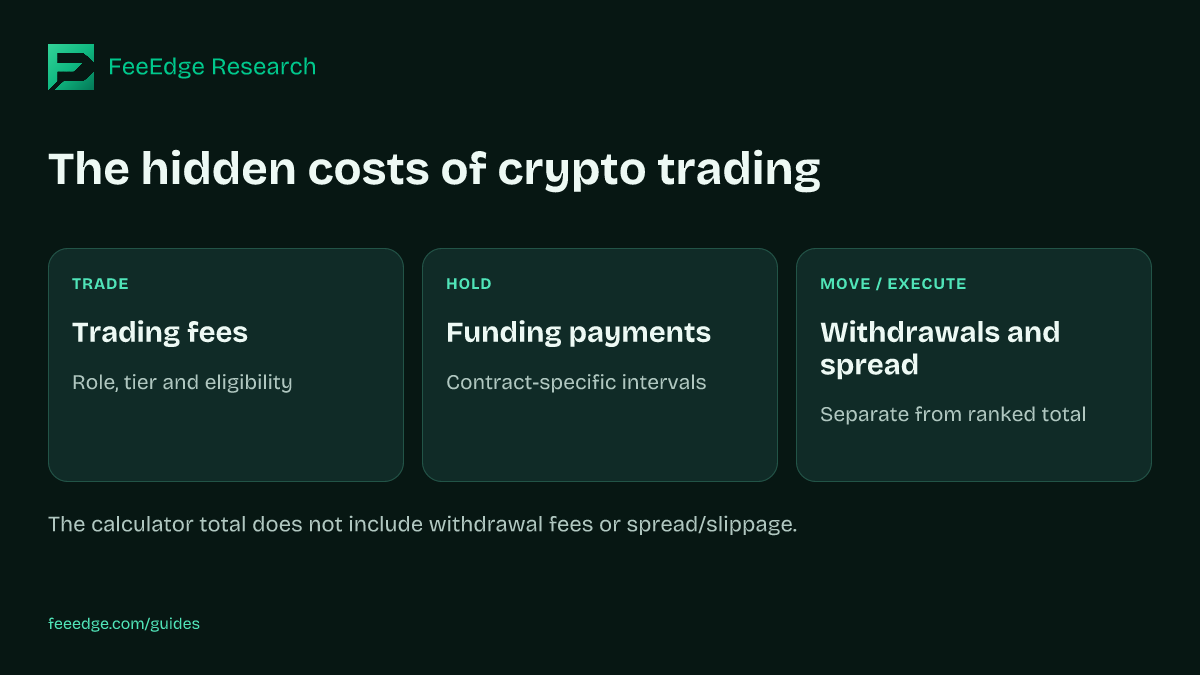
When traders compare exchanges they look at one number: the maker/taker trading fee. But that's only part of what you actually pay. Here are the costs that quietly add up, and why your "cheapest" exchange might not be the one with the lowest advertised fee.
1. Funding rates (perps only, often the biggest)
On perpetual futures, funding can dwarf trading fees. At intervals set by the venue and contract, longs and shorts exchange a payment to keep the perp tethered to spot. Hold a leveraged position through several windows and you can pay more in funding than in fees, without placing another order. The cheapest venue to hold isn't always the cheapest to trade. FeeEdge funding quotes are BTC perpetual. Mixed books are a labeled BTC reference. Withdrawals stay out of the monthly ranking total; compare them separately by asset and network.
2. Withdrawal fees (and the network you pick)
Moving crypto off an exchange costs a withdrawal fee that varies by exchange and network. The same USDT withdrawal might cost ~1 USDT on Tron (TRC-20) but several dollars on Ethereum (ERC-20). If you move funds often, the wrong chain is a recurring, avoidable tax. See network fees and withdrawal costs by chain for the full breakdown.
3. The spread and slippage
The quoted fee assumes you trade at the mid price. In reality you cross the bid/ask spread, and on thin books a market order walks the book (slippage). Less-liquid assets and smaller venues have wider spreads, so the effective cost of trading an altcoin can far exceed the headline fee.
4. Volume tiers you're not hitting
Many exchanges drop your rate as 30-day volume climbs, but not all. CoinW futures have no VIP book, and Binance volume-only stays Regular User. Spread across three exchanges, you might be stuck at the worst tier on all of them, when consolidating onto one could unlock a cheaper tier and save more than switching venues.
5. Native-token discounts you're not using
No current validated native-token discount quotes are available in FeeEdge. A token listing alone does not establish a fee reduction. Check the market, account conditions and token price risk before comparing savings. The native-token discount guide shows which quotes FeeEdge can currently validate. An unavailable quote is not a zero discount.
Add it all up
Real cost = trading fees + funding (perps) + withdrawal fees + spread/slippage, minus volume-tier and token discounts. The lowest headline fee can easily lose to a venue with better funding, cheaper withdrawals, or a discount you'd actually use. FeeEdge ranks published trading commissions across 33 exchanges. Signed BTC funding enters the perp total only when every destination has a valid quote and the profile can use it; otherwise it is shown separately. Withdrawals, spread and slippage stay outside that number. The ranking and basic withdrawal comparison are free.
Compare estimated trading costs →