
Maker vs taker fees explained
Guide revised: . Data verification dates are shown separately in the guide and sources.
Maker and taker describe how an executed order interacts with the book. Their fee rates depend on the venue, product, account tier and eligible discounts. Knowing which role your fills used helps explain what you paid.
What's the difference?
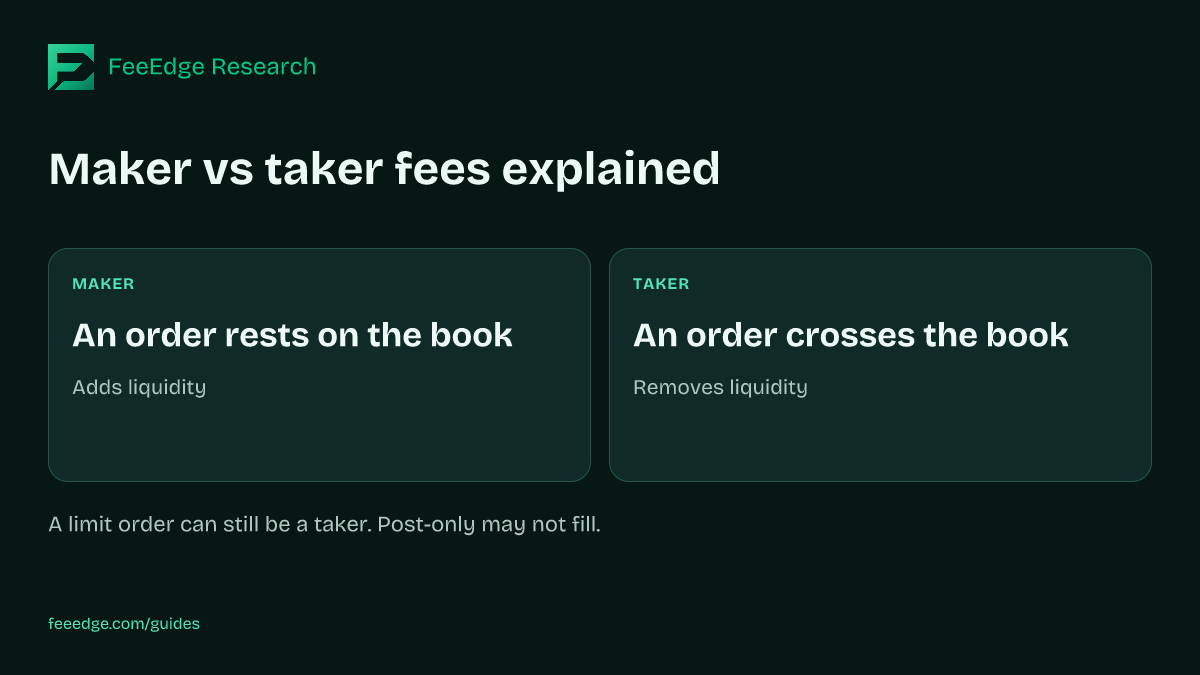
Every exchange runs an order book. Your order either adds liquidity or removes it:
- Maker order: a limit order that rests on the book waiting to be filled. You're "making" liquidity, so you pay the lower fee (sometimes zero, sometimes a rebate).
- Taker order: a market order (or a limit order that fills instantly) that removes existing liquidity. You pay the higher fee for the instant fill.
In a fictitious schedule, 0.02% maker / 0.05% taker: the taker pays 2.5× more for the same notional. This example is not a current account quote.
Why execution role matters
Market orders execute against available liquidity and use the taker rate. That rate may be higher than the maker rate for the same account, but the difference depends on the schedule. A limit order that crosses the book can also execute as taker.
How to pay the maker fee instead
- Use limit orders: set your price and let the order rest on the book.
- Use "post-only" mode where available: it guarantees maker treatment (it won't cross the spread and become a taker).
- Consider execution conditions: a resting limit order may fill partly, much later, or not at all. Queue position and market movement affect execution; a lower commission does not guarantee a better overall result.
The trade-off is fill certainty: a limit order might not fill if price runs away. For fast scalps, takers are sometimes unavoidable, which is exactly why your maker/taker mix matters.
Your mix decides which exchange is cheapest
An exchange with a great maker rate but a poor taker rate is cheap for a patient limit-order trader and expensive for a market-order scalper. That's the idea behind FeeEdge: set your real maker/taker mix and volume, and it ranks every exchange by what you'd actually pay.