
Crypto network fees and withdrawal costs by chain
Guide revised: . Data verification dates are shown separately in the guide and sources.
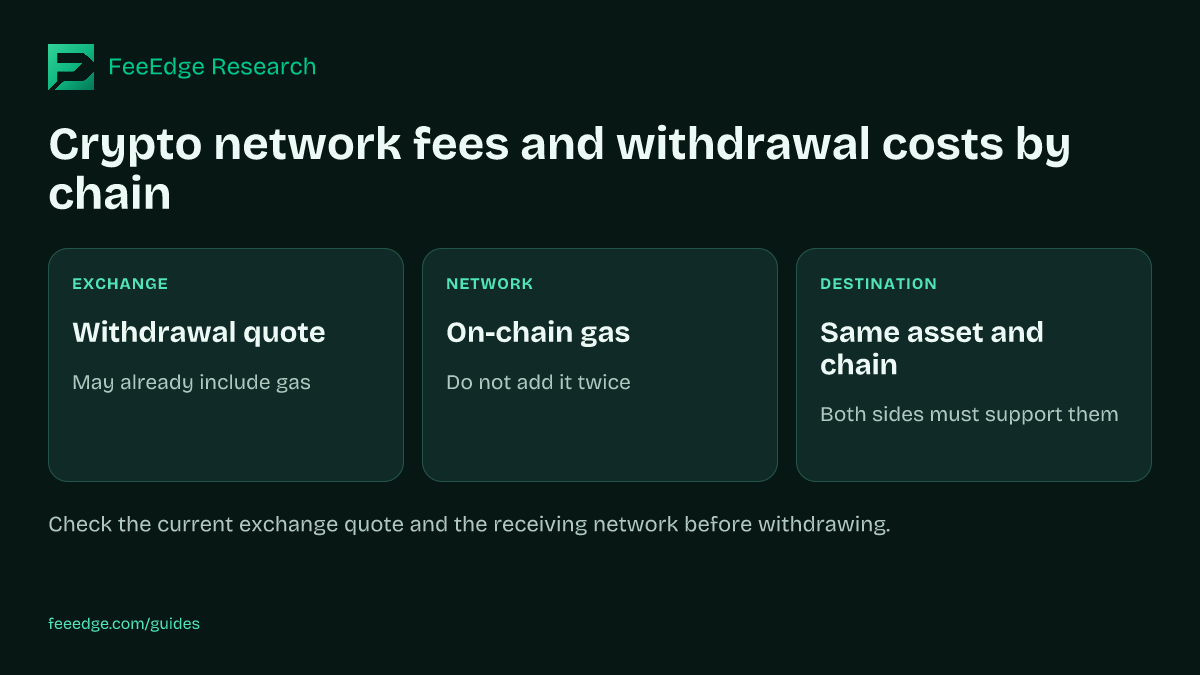
Moving crypto has different costs depending on who sends it. A transfer from your own wallet pays a network fee (gas). An exchange withdrawal pays the withdrawal fee quoted by the exchange, which may already cover its network cost. Do not add a gas estimate to that quoted fee unless the exchange explicitly charges it separately. Both depend on the asset and chain.
This guide breaks down both, chain by chain, so you can see where a transfer actually costs pennies and where it quietly costs you $20.
Network (gas) fees by chain
The network fee is what the blockchain charges to include your transaction. It is the same whether you move funds from an exchange or a self-custody wallet, and it moves with congestion. These are typical ranges for a simple transfer under normal conditions, last reviewed on August 17, 2026. The article update does not revalidate those historical ranges. For a current transfer, use the sender's quote.
| Chain | Typical transfer fee | Notes |
|---|---|---|
| Solana | under $0.01 | Often a fraction of a cent, plus an optional priority fee when busy |
| Polygon PoS | ~$0.002 to $0.01 | Consistently cheap for stablecoin transfers |
| BNB Chain (BEP-20) | ~$0.01 to $0.20 | Low and stable, widely supported |
| Base | under $0.01 to ~$0.10 | Ethereum L2, cheap until it gets congested |
| Arbitrum | ~$0.01 to $0.50 | Ethereum L2, rises with mainnet gas |
| Tron (TRC-20) | ~$1 to $3 | Energy based. Feels cheap but costs real TRX without staked energy |
| Bitcoin | ~$0.50 to $5+ | Spikes hard when the mempool is full |
| Ethereum L1 (ERC-20) | ~$2 to $10 | Can pass $50 during mints and market frenzies |
The order barely changes over time even though the exact numbers do: Solana, Polygon and the L2s live in cents or below, Tron and Bitcoin sit in the low dollars, and Ethereum mainnet is in a class of its own.
The withdrawal fee is a separate, usually bigger cost
Here is the part that catches people out. Your exchange does not simply pass through the network fee. It charges its own flat withdrawal fee per network, and sets it wherever it likes. So a stablecoin transfer that costs the Solana network a fraction of a cent can still cost you 1 USDT to withdraw, because that is the number the exchange picked.
Historical USDT withdrawal examples by network, not current quotes. Check the free withdrawal comparison and confirm the current quote on the exchange.
| Network | Typical withdrawal fee | Notes |
|---|---|---|
| Solana (SPL) | ~0.5 to 1 USDT | Cheapest network cost, modest exchange fee |
| BNB Chain (BEP-20) | ~0.3 USDT | Often the lowest flat fee at Binance |
| Tron (TRC-20) | Varies by venue; confirm the current quote | The default for many, but not the cheapest everywhere |
| Polygon | often under 1 USDT | Cheap where supported |
| Ethereum (ERC-20) | Varies by venue and network conditions | The most expensive way to move a stablecoin |
Notice the gap. The Tron network can cost a few dollars in raw energy, yet several exchanges charge a flat 1 USDT to withdraw over it because they subsidize the energy. Meanwhile ERC-20 is expensive on both counts. The network you select at the withdrawal screen usually matters more to your bill than which chain is technically the cheapest to run.
Cheapest way to move a stablecoin
For USDT or USDC, the practical winners are Solana, BNB Chain and Polygon, with Tron a habit worth rechecking rather than a default. As a rule: match the network to what both the sending exchange and the receiving wallet support, then pick the cheapest option they have in common. Sending on the wrong network that the destination does not support is the one mistake that actually loses funds, so confirm the network on both ends before you send.
When Ethereum L1 still makes sense
Paying ERC-20 fees is worth it in a few cases: moving to a wallet or protocol that only lives on Ethereum mainnet, transferring an amount large enough that a $10 fee is a rounding error, or interacting with a contract that has no L2 deployment. For everyday stablecoin movement it rarely is.
How to cut on-chain transfer costs
- Withdraw over the cheapest network both sides support, not whatever is preselected.
- Avoid ERC-20 for stablecoins unless the destination requires it.
- Batch withdrawals into fewer, larger transfers instead of many small ones, since the fee is usually flat per withdrawal.
- Keep a little of a chain native token (SOL, BNB, TRX) in self-custody so you are not forced onto a pricier network to move funds later.
- Compare the exchange withdrawal fee, not just the gas. Two venues on the same network can charge very different amounts.
Where this fits into your real cost
Withdrawal and transfer fees are one of the quiet costs that make a low headline trading fee misleading. If you move funds often, the wrong network is a recurring tax that can outweigh the fee difference between exchanges. The FeeEdge calculator ranks estimated trading costs across 33exchanges and shows withdrawal fees separately by asset and network. Withdrawals are not included in the monthly ranking total. The basic withdrawal comparison is free, without an account. Check current fees and route availability on the exchange before sending funds.
Gas and withdrawal fees change constantly with network demand and exchange policy. The figures here are typical ranges for orientation, not live quotes. Always check the current fee on your exchange and the network status before you send.