
How to reduce your crypto trading fees
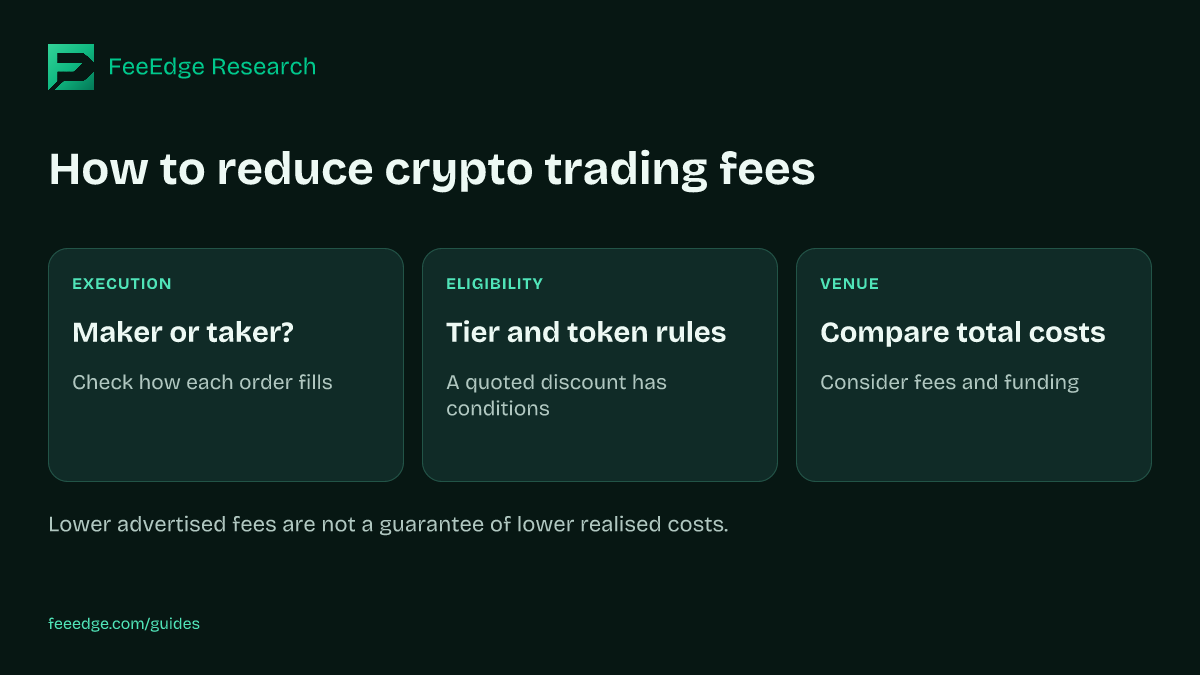
Guide revised: . Data verification dates are shown separately in the guide and sources.
Trading fees are one of the few costs you fully control. Over a year of active trading they add up to real money, and shaving them is pure profit. Here are seven ways to pay less, roughly in order of impact.
1. Trade with maker (limit) orders
Orders that rest on the book add liquidity and can pay a lower maker fee. A limit order that crosses the book is still a taker; post-only avoids that conversion but may leave the order unfilled. Compare the applicable rates and the execution trade-off. See maker vs taker fees explained.
2. Pick the right exchange for how you trade
Base fees vary several-fold across venues, and the cheapest one depends on whether you trade perps or spot and on your maker/taker mix. Don't assume your current exchange is cheapest. The FeeEdge calculator ranks all 33 for your exact profile.
3. Climb the volume tiers
Many exchanges lower your rate as 30-day volume rises, but not all. CoinW futures stay on a flat Regular book. Binance volume-only stays Regular User; VIP needs BNB. If your volume is split across several exchanges, you may be stuck at the worst tier on all of them. Consolidating onto one venue can unlock a cheaper tier and save more than switching.
4. Use a native-token discount (if you trade there anyway)
Some exchanges cut trading fees when you hold or pay with their native token. See the native-token fee discounts guide for currently validated quotes and their availability. A missing quote may reflect unverified or outdated evidence; it does not mean that the venue has no discount. Check the account and market conditions, then compare the possible fee savings with the required token balance and its price risk.
5. Mind funding on perps
On perpetual futures, funding exchanged at venue- and contract-specific intervals between longs and shorts can cost more than the trading fee if you hold positions. The cheapest venue to trade isn't always the cheapest to hold, factor funding into your real cost.
6. Choose the cheaper withdrawal network
Moving coins off-exchange costs a withdrawal fee that varies by network. The same USDT might cost ~1 on Tron but several dollars on Ethereum. If you withdraw often, the wrong chain is a recurring, avoidable tax.
7. Account for the spread
The quoted fee assumes you trade at mid price; in reality you cross the bid/ask spread, which is wider on thin books and small venues. For less-liquid assets the effective cost can far exceed the headline fee. Trade liquid pairs and use limit orders to control it.
Add it up
Real cost = trading fees + funding (perps) + withdrawal fees + spread, minus volume-tier and token discounts. FeeEdge ranks published trading commissions across 33 exchanges. Signed BTC funding enters the perp total only when every destination has a valid quote and the profile can use it; otherwise it is shown separately. Withdrawals, spread and slippage stay outside that number. The complete ranking is free, without an account.