
Native-token fee discounts, compared
Guide revised: . Data verification dates are shown separately in the guide and sources.
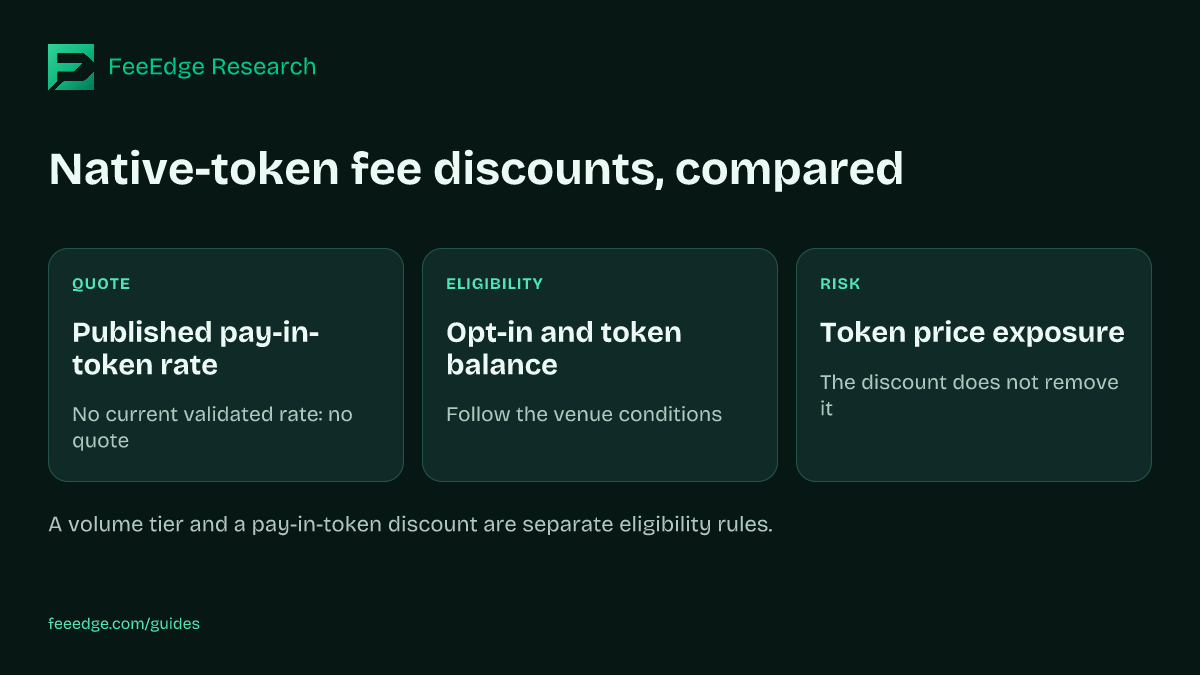
Some exchanges offer a fee reduction for eligible token holders or token fee payments. The market, account tier, opt-in settings and balance requirements matter. A token listing alone does not prove a discount. FeeEdge only quotes rates with current validated evidence.
Currently validated discount quotes
No current validated native-token discount quotes are available in FeeEdge.
| # | Exchange | Token | Fee discount |
|---|---|---|---|
| Quotes are unavailable until the evidence is revalidated. This does not mean a zero discount or that no exchange offers one. | |||
When quotes are available, they are sorted by the quoted spot discount; a futures discount is shown separately where validated. Exact terms vary by venue and can change. No current validated quote in FeeEdge for: Binance, Gate.io, Bitget, KuCoin, HTX, WhiteBIT, BitMart, CoinEx, Aster. Evidence may be unverified or out of date; check the official fee schedule for your account and market.
The catch
Compare the fees you would save at your trading volume with the token balance required and its price risk. Check the market, account eligibility and fee-payment settings. A fee discount does not guarantee that holding the token will save money overall.
Compare eligible costs
Compare the eligible discount with the venue's base fee for the same market. FeeEdge keeps the complete base-fee ranking free. Pro adds native-token modeling only when a current validated quote is available. An unavailable quote does not establish a zero discount.
Compare published trading fees